I spent another fascinating day yesterday, training as part of the Texas Master Naturalist program. But first, here is how my day started.
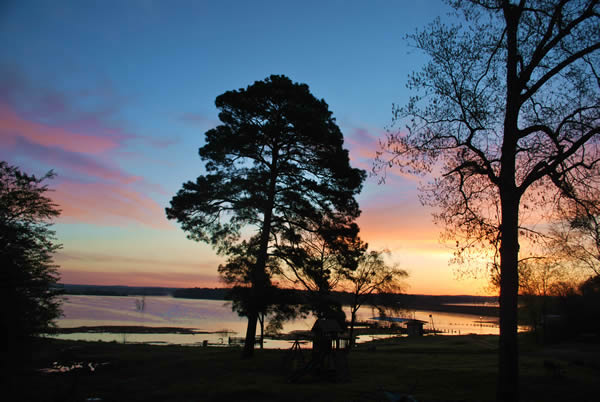
This was the view from my front door when I got up Saturday morning to get ready to go for my training at Caddo Lake. (I live at Lake O' the Pines).
Friday evening included a short course in Entomology. The presenter was Allen Smith, an entomologist with the Texas Forestry Service. He brought along his traveling insect collection that was quite interesting. Even more interesting were his personal anecdotes about being a life long insect collector. These revelations produced smiles, some laughter and in more than one case, comments that included the phrase ". . . your poor wife". Overall, it was an interesting and entertaining event.
The training continued on Saturday morning with "Volunteers as Interpreters" taught by Barbara Parmley, who is with the Texas Parks & Wildlife. Most of our class is made up of teachers or those with at least some teaching experience which may have made this a particularly interesting topic for us. We were introduced to the basics of interpreting our knowledge of nature in a practical way to enhance the enjoyment and to increase the knowledge & appreciation of our audience.
 On Saturday afternoon, we covered Ichthyology with Timothy J Bister with the Texas Parks and Wildlife. It was mainly on the basics of ichthyology and was a good refresher course for me. I am afraid that I must admit ichthyology was not a big interest of mine in past years. Just like with trees & other plants, I just never really got that interested in fish other than catching them for sport. It is another short coming that I hope to correct.
We got to do a couple of activities which were fun. The first one was using a dichotomous key to identify some local fish. The fish were caught the night before using a "electrified" boat. This was the first time I had used a dichotomous key since I made one many years ago to identify the reptiles of the Permian Basin. Using one for fish was challenging since none of us were familiar with some of the more obscure physical characteristics, but we muddled through.
The activity that I really enjoyed was determining the age of a couple of the fish by examining the sagitatal otolith.
Otoliths are agglutinated crystals found in the inner ear of fish (and other vertebrates) that have various functions mostly related to detect movement and direction of movement. As the fish ages, otoliths increase in size by adding more crystalline material to the outer edges. This creates rings as new growth is added. The growth rate is largely influenced by the seasons. Slower growth rates in the winter result a more dense "ring"; faster growth results in a light "ring". This in effect creates a series of rings from which their age can be determined much in the same manner as examining the rings from a tree trunk. Each ring represents one season. By counting the more dense rings (more white than clear), you are counting the number of years.
 There is a bit of messy work to get to the otoliths, but that is all part of the fun. The method we were shown was to turn the fish upside down and cut into the "throat" just in front of the gills. From there you can get to a bony plate that you score and break open or carefully cut to expose the dorsal portion of the skull. On each side of that are the ears. The otoliths are then extracted from the ear using forceps.
The rings can be seen with a magnifying glass but it is difficult at best. We were provided with a dissection scope which made the rings more easy to see.
I knew that with some fish, their age could be determined by examining the scales, but this was sometimes very difficult to do. The rings on scales are not always clearly visible. This method with the otoliths is much more practical.
There are so many fascinating things about nature. I enjoy almost every aspect. This weekend was fun starting with the interesting tid bits and personal anecdotes that went with the basics of entomology. Of course it was fun to see the insects that he had on display. The training on interpreting nature to others was also good and very practical for it is one thing to enjoy nature and quite another to translate that joy into actions that create interest and appreciation in others. I enjoyed the instruction on ichthyology. It was really fun to use the dichotomic key to identify the different species of fishes. And, for some reason, I particularly enjoyed determining the age of the fish using the otoliths.
It was a very good weekend. I feel that I learned some significant things. It was also fun to be with a group of people who also enjoy nature and are appreciating the things we learned. I am not sure some of them enjoyed cutting into the fish to dig out the otoliths quite as much as I did, but I know they still appreciate the knowledge.
The social aspects of all of this training is as important as the knowledge. I can learn on my own, but it is not near as much fun or fulfilling as learning with others who share the same joy. That is something that I have really missed. I am not sure that I realized just how much. When I was a kid, most of my nature activities were on my own. Oh, I did have a friend now and then that went with me 'hunting snakes" but none of them had the real interest in it that I did. None of them spent hour after hour, night after night, year after year, delving deep in one book after another learning everything I could about all the animals in the woods (and in my cages, aquariums, and running loose in my room). It was only when I got into college that I found others were a little "bent" and shared that love of animals and nature. Not all of them enjoyed snakes, but I had so many friends who couldn't wait to head out into the woods or desert with me. They might be fascinated by "Pogos" (Pogonomyrmex. Yes, I remember, Charles and his red ants) or spadefoot toads (Chuck and his "denizens of the night") or obscure plants (Ed - "No, that isn't peyote"). They didn't care that I was looking for snakes and I didn't care that they were looking for something else. We loved getting out and spending time together, sharing the experience, sharing the knowledge that we had and sharing that bond of nature.
It is a joy to be around people like that again.



 Michael is a former biologist and Texas Master Naturalist. Originally from Newsome, Texas (Between Pittsburg and Winnsboro), educated in Dallas & Garland schools, then off to the University of Texas system where he received a degree in biology and worked as a biologist with the University of Texas system. After many years away from nature and biology, he relocated to the banks of Lake O' the Pines where he has been rediscovering the joys of nature. He is somewhat surprised that he has become a birder. Most of his interest in nature was centered around reptiles. Perhaps just like birds evolved from reptiles starting in the late Jurassic, he has begun his own evolution. During his formal education, his interests in biology/nature grew to include community ecology and population studies, all with a binding of evolutionary processes. He liked birds, but they were secondary at best. All at once he finds them fascinating.
Comments