With Spring coming, I start to get antsy. We have had some warm days and nights lately (in February) and the other afternoon I heard tree frogs calling. It won't be long before the pond and creek bottoms are blackened by little tadpoles. There is no telling how many thousand of them that I killed . . . uh caught as a kid, put in a jar or aquarium and watched for hours. I meant well but the mortality rate was high. Of course, it is in nature, too.
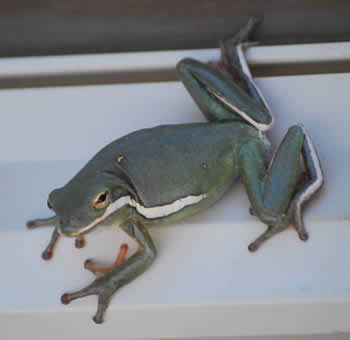 Each male and female frog may have many hundreds eggs. In order for the frog population to remain stable, only two need survive and in most cases that is what happens. Otherwise, we would be knee-deep in frogs.
Did you ever wonder what happens during the Springs that don't get enough rain for the frogs to successfully breed? Here in east Texas, that doesn't happen often but when it does, there is an interesting development (no pun intended).
During a dry Spring, at the first little bit of rain, frogs will suddenly appear and begin their breeding choruses. You will hear them calling in large numbers. Then the breeding starts, even if there are only puddles. If the puddles are deep enough or if there is more rain soon, the tadpoles may develop after a few weeks and become little frogs. However, if the puddle dries up, so do the tadpoles for they must have water to survive.
A funny thing happens if there is another rain after that. The frogs come out again and go through the same process. When the tadpoles emerge, they actually grow a little faster. If the puddle is big enough or there is a little more rain, they will develop into little frogs but they do so a little faster than the earlier batch that died when the pond dried up. If they are not fortunate enough to develop before the puddle dries out, they do die.
Then it gets even more interesting. If it rains again soon, the process starts over again, but this time, the little tadpoles really grow much faster. They may develop in half the time that the first group of tadpoles would have taken. The first group developed slowly but took too long and died. The second group developed faster but still took too long and they to died. The next group grew very quickly and were able to develop before the puddle dried up.
How is that possible? Do they "know" that it is a dry Spring and that they have to develop fast or die like the previous broods? Was there something different in the breeding process that caused this batch to be able to grow faster; was some vigor passed on from the adults who "knew" the first populations took too long to develop. How in the world would that work? What kind of mechanism could cause that?
Well actually it is a lot more simple than that. For you see, when the pond dried up the first time, the dead tadpole bodies dried out in the mud. When it rained and the new tadpoles came, they fed on the added nutrients that the previous brood of tadpole bodies created. In other words, they were feeding upon the decomposed bodies of the earlier tadpoles. When the pond dried out again, the new brood of tadpoles became an even more concentrated mass of nutrients. The next brood of tadpoles had a tremendous amount of nutrients in their water and their development was much faster. They had a much greater chance of surviving because they fed on the bodies of those who proceeding them.
How cool is that? Nature is so amazing in ways. Even when the environment changes, some organisms "find" mechanisms that allow them to survive. There are limits to that, of course. A prolonged drought of many years could be catastrophic, but there are mechanisms that allow adult frogs (and toads) to go for very long periods without water, even years. Maybe we'll talk about that some other time.


 Michael is a former biologist and Texas Master Naturalist. Originally from Newsome, Texas (Between Pittsburg and Winnsboro), educated in Dallas & Garland schools, then off to the University of Texas system where he received a degree in biology and worked as a biologist with the University of Texas system. After many years away from nature and biology, he relocated to the banks of Lake O' the Pines where he has been rediscovering the joys of nature. He is somewhat surprised that he has become a birder. Most of his interest in nature was centered around reptiles. Perhaps just like birds evolved from reptiles starting in the late Jurassic, he has begun his own evolution. During his formal education, his interests in biology/nature grew to include community ecology and population studies, all with a binding of evolutionary processes. He liked birds, but they were secondary at best. All at once he finds them fascinating.
Comments
Wonderful blog, Michael! Thank you! You are so right - Nature is just so amazing!
Wow!! Fascinating facts about "arrested" tadpole development and how it benefits the next generation - I learn from your posts every time!! Thanks for another wonderful blog!