East Texas Naturalist Blog

Information and photographs mainly about nature in east Texas. Our authors have widely diverse backgrounds and write on a variety of topics.

If you write about nature in east Texas and would like to join us here, please contact us.

Northeast Texas Bird Report - February 2016

This is the NETFO bird report for February.  A Vermilion Flycatcher, a Painted Bunting, Sandhill Cranes and an American Bittern top this month’s highlights.  Thanks to all who birded and sent in their results and thanks again to Luanne for everything.


Greater White-fronted Geese were restricted to RC WMA in Freestone county with a max of 25 photographed on 2/14 (ebird MS).  Noted in six counties the max of 200 Snow Geese were tallied in Bonham in Fannin county on 2/13 (ebird ML).  The single Ross’s Goose at Lake Bob Sandlin that has been there for a long, long, long time, has a friend!  I believe it was three winters ago when this happened before, so for now they are a pair (DB,LB).   The only other report of Ross’s Geese came from Bonham where 50 were tallied on 2/13 (ebird ML).  Found in 13 counties, the peak of 120 Canada Geese were tallied in Fannin county flying north on 2/12 (ebird HL).  

Continue reading
Tags:
Rate this blog entry:
2
2754 Hits
0 Comments

Paradise Lost?? The Perils of Living on the Edge...


January is a busy backyard bird-feeding month here in east Texas.  It's wintery enough for birds to receive handouts from us bird lovers in the form of black oil sunflower seeds.  For the lucky birds in our backyard, we are spoiling them with a fine mixture of a songbird seed mix including safflower. They do love it - we have a large flock of goldfinches that have taken up residence here at the edge of the woods, and they play very nicely with our year-round population of cardinals, blue jays, house finches and Carolina wrens. The Carolina chickadees and white-breasted nuthatches also welcome their similarly sized new feeder mates with hospitality. The red bellied woodpeckers and downy woodpeckers generously share birdfeeder space with them as well, and our new visiting brown thrasher pecks and claws the ground in and around the azalea bushes and mulched areas along with the goldfinches, white throated sparrows and black-eyed juncos.  It has seemed like a birds' paradise - everyone getting along nicely, no bullies upsetting the peaceful coexistence of so many species sharing the space together.  Even the squirrels seem to have tapered their frenzied eating - helped in part by the baffles we've installed on a couple of the feeder poles.  

Ah, yes...all is well with the world, until reality bears its brutal head in the form of a hawk with sharp talons, an appetite for birds, and an opportunistic mind.  At least one Accipiter has brought this peaceful paradise back to the reality of this world - birds are prey to birds of prey, in the form of Cooper's hawks and sharp-shinned hawks, and they have found their opportunity at our backyard birdfeeder paradise.  

These two species of hawks, as I have learned, are somewhat difficult to differentiate in the field.  Both inhabit east Texas, both juveniles are similar in appearance, and both have a craving for their own kind, even if smaller than themselves.  I have wondered if I should post a sign for my seed eating friends near the feeding poles reading, "Eat at your own risk - cannibalism is sometimes practiced here".  Our little birds have learned the drill - when the unwelcome bird-eating guest swoops out of nowhere, they immediately hide in the bushes, or stand dead still within the camouflage of leaf mulch and vegetation.  Now it is a battle of wills and patience.  Who will move first?  Who will give up first?
Continue reading
Rate this blog entry:
4
Recent Comments
Michael Mathews
I enjoyed your blog and the observations were interesting. I have one in the pipes about my feeders too, but it will pale in comp... Read More
Friday, 29 January 2016 14:15
Kristi Mears Thomas
Jill, I whole-heartedly agree with Michael...such a lovely job! I enjoy reading about your backyard guests, both welcome and unwe... Read More
Sunday, 31 January 2016 08:53
2676 Hits
2 Comments

Water, Water, Everywhere . . . 2016 will be a Great Year!

HighWater

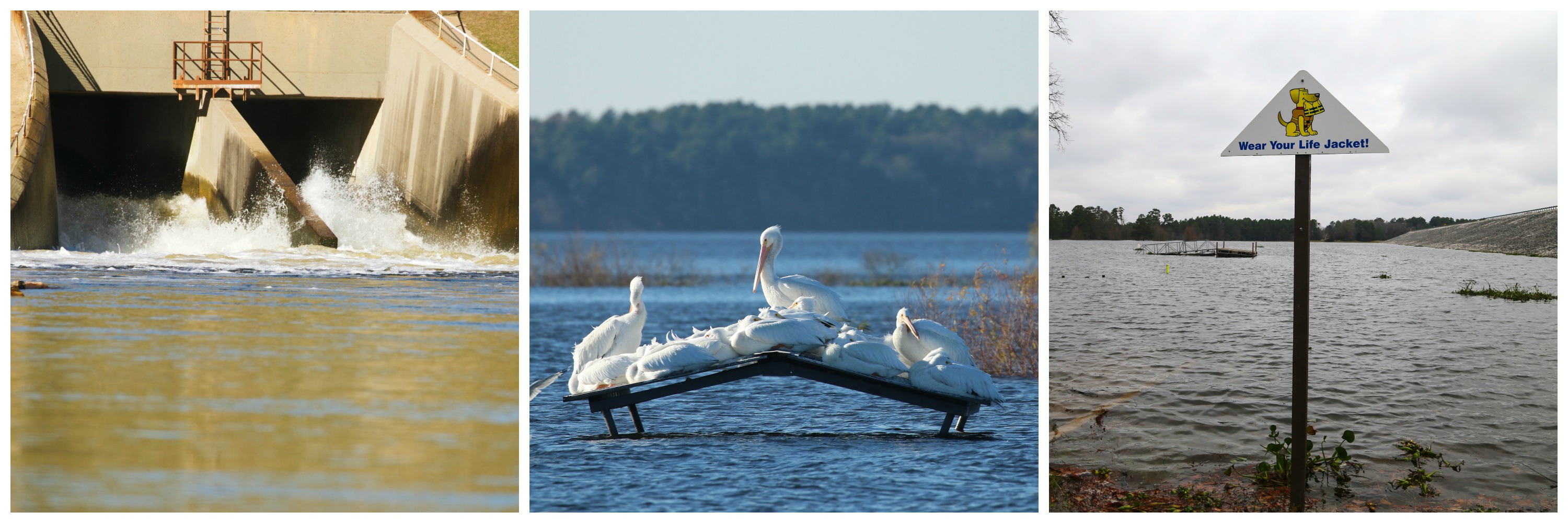
   As we look around us now, it's hard to imagine that not very long ago we were commiserating about the lack of rain and considering hosting community rain dances!  Our area lakes have seen some low levels, but Mother Nature more than made up for the long-withheld wet stuff in December.  Over a course of just one weekend, we saw that deluge of water hyacinth, many of the parks and launch ramps closed, and pelicans roosting on the last bit of tin on the tops of day use picnic tables!

   While it's been beautiful to see the area resoirvers filled to the brim, this double-edged sword is not without consequence....yes, the birds and other wildlife seem to love it, but if you were one of the fortunate folks who live lakeside and had to watch a few weeks back with bated breath as Lake O' the Pines jumped by leaps and bounds, it wasn't such a thrill. Friends and family in the surrounding areas had this predicament, and this tradeoff is not so nice if it's in YOUR back yard, lapping at YOUR door, or mangling YOUR dock! I'd actually taken some photos on Lake O' the Pines that I wanted to post, but did not because it felt wrong.  I know too many people that were either trying to procure sandbags or having to travel alternate routes to get to and from their homes to feel good about doing so.

   From data on the Corps of Engineers website, Lake O' the Pines was a high of nearly 242 feet, and is dropping now and at under 240.  Current release rate is 3,000 CFS, the maximum, so the Big Cypress Bayou is looking good, too.  This is 12 feet above normal winter pool.  Lake Wright Patman saw record levels of almost 255 feet, and was a whopping 33 feet above normal!

Continue reading
Rate this blog entry:
5
Recent comment in this post
Jill Wright
Beautiful photos and great information about the rains and their affect on Lake O the Pines, Krisiti!! Let's hope we have an amaz... Read More
Friday, 29 January 2016 12:24
2318 Hits
1 Comment

There's Another Stupid Cardinal or How Familiarity Breeds Contempt

Cardinal011216

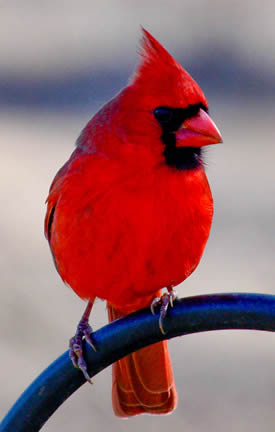
If you only saw one Cardinal a year, think how much you would appreciate their beauty.  The male Cardinal in breeding colors is one of the most beautiful single colored birds in the world. Their fairly large size, their black mask and crest give them a distinctive and almost regal manner.  Many birdwatchers all over the world outside of the U.S. view the Cardinal as a huge prize on their Life List. 

Ah, but in my yard where I can hardly look out the window without seeing a Cardinal, their value as a noteworthy sight on my bird feeders honestly is not high.  It is not that I don't see their beauty.  It is just that I see it every day over and over again.  

I'm not so crass as to not appreciate them at all, for one can't help but feel some joy in their beauty.  Today, there were four males and at least five females around my yard (with ten feeders).  I enjoyed watching them, along with the Goldfinches, Dark-eyed Juncos, White-throated Sparrows, House Finches, Carolina Chickadees, Tufted Titmice, a single Pine Siskin, Chipping Sparrows, a Mockingbird and a couple of Song Sparrows.  It was a busy day on the feeders.

Continue reading
Rate this blog entry:
11
Recent Comments
Kristi Mears Thomas
Love this, Michael! An inspiring message, and one that I have been thinking myself lately...we sometimes get so accustomed to the... Read More
Wednesday, 13 January 2016 07:03
Jill Wright
Great blog, Michael! That is one handsome cardinal, and you got an amazing photo of him. It is great when the scales are peeled ... Read More
Friday, 29 January 2016 12:21
2741 Hits
2 Comments

The Fine For Picking Up Feathers is Anything But Lightweight

FWS logo2005

There is no telling how many feathers I collected a kid.  I did that without ever killing a single bird for in the woods, I found feathers everywhere.  I had feathers from blue jays, crows, cardinals, doves, sparrows, mockingbirds, ducks, owls, hawks and dozens of other types of birds.  I had a very nice collection that I took to school and showed everyone.  Back then, no one thought anything about it.  Now, possession of those feathers would be a major problem.  Fines in the thousands would be coming and maybe jail time.  Today, it is a big deal.

Most birds are protected by the Migratory Bird Treaty Act (MBTA) which makes possession of feathers or other parts of the bird to be illegal.  The idea of this is to protect wild birds from being killed for their feathers and in some cases, their claws or beaks.  There has always been a market for these items by collectors and for commercial trade.  It does not matter how the feathers were obtained.  You can't pick them up off the ground, pluck them from a dead bird on the road or get them from a dead bird your cat left on your step.  This is absolute.

For more information about the MBTA included a list of which species are included (almost all birds) visit the FWS website at http://www.fws.gov/migratorybirds/regulationspolicies/mbta/mbtintro.html.  

Continue reading
Rate this blog entry:
6
2645 Hits
0 Comments